
Blind by Design: The Army's Emerging Reconnaissance Shortfall
The views expressed are those of the authors alone and do not reflect the official policy or position of the United States Army Intelligence Center of Excellence, Department of the Army, the Department of Defense, or the United States Government.
Introduction
For most of the last forty years, a brigade in the United States Army that needed to see beyond its forward units had a battalion-sized formation for the job. From 2004 onward, that formation was a cavalry squadron inside the brigade, and above the brigade sat long range surveillance units at division and corps. In the last five years, the Army removed most of these formations. In their place it created the Multi-Functional Reconnaissance Company (MFRC), a single company that combines infantry scouts with small unmanned aircraft systems (UAS), electronic warfare sensors and jammers, robotic systems, and loitering munitions. The Army then rapidly began to convert all of its Infantry Brigade Combat Teams (IBCT) into Mobile Brigade Combat Teams (MBCT), each with an MFRC, and began extending the concept to Stryker (SBCT) and Armored Brigade Combat Teams (ABCT). While the Department of the Army made these decisions in an attempt to modernize the force in the wake of the Russo-Ukrainian War, they would have significant, unintended consequences.
The authors do not dispute that the MFRC is a sensible response to what the war in Ukraine has shown about drones, electronic warfare, and the danger of being seen. The question this paper asks is narrower and harder: can one company, however well equipped, carry the reconnaissance and information collection load that battalion-sized formations previously carried in the sustained fighting between major military powers that the Army now plans for?
A single analogy is used to organize this paper: the human eye. An eye has three parts: the retina gathers light, the optic nerve carries the signal, and the visual cortex in the brain turns the signal into something a person can act on. Damage any one of them and a person cannot see, even if the other two are healthy. In this analytic product, the retina is the MFRC’s scouts and sensors, which are capable and improving. The optic nerve is the command, staff, sustainment, and communications that let a unit keep looking for days and pass what it sees. The visual cortex is the data platform where collection becomes intelligence. The Army has built a good retina, but has neglected to build the nerve or the cortex to match, so Army brigades are at risk of being blind by design.
This product makes four claims. First, the MFRC took on a large share of the tasks of three precursor formations without their command structure or organic sustainment. Second, it has no doctrine and no common organizational design. Third, a company-sized unit cannot watch as many places as it is asked to for long once losses, sustainment, and maintenance are considered. Finally, the path from the company’s sensors to the Army’s intelligence platforms is ineffective, with significant delays that hamper an effective killchain.
The paper does not claim that the MFRC concept is wrong, that its soldiers or leaders are performing poorly, or that the cavalry squadron should simply return. Nor does it claim that drones cannot replace people for reconnaissance. It does not claim knowledge of any unit’s actual authorized strength or equipment, which is not public, so its judgments about how much a company can watch rest on published size ranges rather than unit data. By design it contains no controlled force structure data, no system performance specifications such as ranges, frequencies, or endurance figures, and no vulnerabilities of fielded equipment.
The Lineage: What the MFRC Replaced and How It Arrived
The MFRC is the latest turn in a long cycle of building, cutting, and rebuilding Army reconnaissance architecture. Three predecessors were extremely influential on the MFRC's development: long range surveillance units, the reconnaissance, surveillance, and target acquisition (RSTA) squadron of the Stryker brigade, and the cavalry squadrons of the brigade combat teams. Each was cut with much the same explanation: the Army could keep the capability while spending less, because technology would cover the difference.
Each was responisble for a different component of a manuever formation's information collection plan. Long range surveillance (LRS) units sent small teams on foot deep behind enemy lines to hide, watch, and report for division and corps commanders (O’Dawe, 1990; Meadows, 2000); they were reduced in the 1990s and gone from the active force by 2017 (Meadows, 2000; Horton, 2017). The RSTA squadron, designed around 2000, paired mounted scouts with unmanned aircraft, ground sensors, and radio-frequency detectors to gather information without having to utilize direct fire (Willis & Davis, 2000; Dolberry, 2018). Cavalry squadrons, which came to every BCT in 2004 (Jennings, 2017), reconnoitered ahead of their parent units and secured them from surprise with their own commander, staff, and support, until the Army inactivated them in IBCTs and SBCTs in 2024 (U.S. Army, 2024).
The company that replaced them was born in an experiment and scaled by a directive. Under the 2024 program Transformation in Contact (TiC), the Army gave new equipment and organizations to three IBCTs in the middle of their training cycles: 2IBCT, 101st Airborne Division, 3rd IBCT, 10th Mountain Division, and 2IBCT, 25th Infantry Division. The 101st Airborne became the prototype MBCT, fielding more than 200 Infantry Squad Vehicles, and standing up the first MFRC in March 2024 (AUSA, 2024). Its first training rotation, at the Joint Readiness Training Center (JRTC) at Fork Polk, Lousiana that August, exposed problems that would prove lasting: soldiers used commercial drones and electronic warfare equipment in ways their training had not fully prepared them for and repaired equipment beyond what they had been taught, the application meant to stream drone video to commanders and fire support through a command and control (C2) system was inoperable, and the company’s C2 system gave off signals an enemy could easily detect, which limited its use (Skove, 2024). The other two brigades tried competing answers; one leaning largely on drones and the other on a reconnaissance and strike company of its own design (AUSA, 2024; Parrott, 2025). A second army program, TiC 2.0, extended the experiment to Armored and Stryker brigades in 2025 (AUSA, 2024; Chalfont, 2025). Across both phases the trend was the same: small sense-and-strike units at every echelon, which spread drones and electronic warfare widely but also spread reconnaissance across many small headquarters, none of which had a staff (Tateyama, 2025; Chalfont, 2025).

The directive to adopt the organization arrived before the experiment was complete. On May 1, 2025 the Secretary of the Army and the Chief of Staff launched the Army Transformation Initiative (ATI), which directed that all IBCTs convert to MBCTs, each with an MFRC (Driscoll & George, 2025; Feickert, 2026). The same initiative merged the Army’s training and doctrine command with its futures command to form the Army Transformation and Training Command (T2COM) and folded Forces Command into a new Army Western Hemisphere Command (AUSA, 2025; CRS, 2025a). In a little over a year, the MFRC became the reconnaissance formation of every MBCT, before the experiments that produced it had completed and before any doctrine had been written.
Two years on, the public record suggests that many of the problems that first rotation exposed have yet to be fixed across the force. Collection from company sensors still reaches brigade staffs largely by human relay and manual re-entry, and in 2026 the Army’s own intelligence program office described its platform as lacking a cohesive way to reach the tactical edge under degraded connectivity (Intelligence Community News, 2026b). The Armor School was still writing standards for drones, counter-drone systems, and emissions control in late 2025 (Chalfont, 2025), and the formal drone specialty meant to relieve scouts of flying and fixing their own aircraft was created only in 2026 and will take years to fill (U.S. Army, 2026d). Because every brigade is responsible for building its own MFRC, with no common organization and no doctrine to guide it, a fix found in one brigade does not automatically travel to the next, and each unit meets its own version of these problems. A brigade that forms its company from soldiers it already has, with no added personnel, struggles first with manning. One that assembles its company from pieces of several units struggles to integrate their soldiers, equipment, and tactics. One whose support battalion has moved to division feels the sustainment problem most sharply, while one that kept a squadron staff above its sense-and-strike element is spared much of the command problem. Every MFRC is different, as the Army’s reconnaissance school puts it (Wiley, 2025), and so is every MFRC’s list of unsolved problems.
No mission essential task list (METL), the short list of tasks a unit must be able to perform to accomplish its mission, has been published for the MFRC. What it inherited can still be read from what its predecessors did and what published descriptions now ask of it. From the cavalry squadron it took the brigade’s core reconnaissance work: finding the enemy and learning the terrain ahead of the brigade, now concentrated in the deep area beyond the brigade’s fighting units (Puryear, 2025b). It also took counter-reconnaissance, finding and destroying the enemy’s scouts, and in practice the brigade’s security tasks, such as screening to give early warning, because the brigade has no other unit to give them to; the infantry battalions’ Multi-Purpose Companies now handle security only for their own battalions (Tateyama, 2025). From the LRS units, it took stealthy surveillance by small teams that hide, watch, and report, and the course that once certified LRS soldiers now trains MFRC scouts (Wiley, 2025). Added to all of this is a task none of its predecessors owned outright: targeting and strike. The MFRC is the brigade’s primary reconnaissance and targeting unit, expected to find a target and attack it with its own drones and loitering munitions (Tateyama, 2025; Puryear, 2025b).
Two things did not come with it. The deep LRS mission at division and corps depth did not transfer, and the Army’s own reconnaissance school now asks whether LRS units should return at division (Wiley, 2025). Nor did the structure: the squadron commander and staff, the forward support company, and the size that let a squadron rotate troops through sustainment and maintenance while others kept watching. In short, the MFRC inherited the task list of battalion-sized units with the people and headquarters of a company.
Doctrine: A Mission Without a Manual
That haste with which the MFRC was adopted shows most clearly in doctrine, the Army’s written body of shared ideas about how to fight. Doctrine does not dictate what a commander must do. It gives every leader the same vocabulary, planning factors, and expectations, so that a brigade staff knows what it can ask of a unit and the unit knows what it will be asked. A formation without doctrine can still fight well, but only as long as the people who invented its tactics, techniques, and procedures (TTP) hods remain in it. The Army’s reconnaissance and security manual, Field Manual (FM) 3-98, was last issued in January 2023. It addresses cavalry squadrons, cavalry troops, and the scout platoons of maneuver battalions, and organizes reconnaissance and security around those units (HQDA, 2023a). It does not describe a company-sized, multi-function reconnaissance formation working directly for a brigade, because no such formation existed when it was written.
An instructor at the Reconnaissance and Surveillance Leaders Course, which trains more than 300 students a year from across the joint force, acknowledged in 2025 that every MFRC is different, that no doctrinal publication defines their employment, and that units are writing doctrine as they go (Wiley, 2025). An officer in a seperate prototype brigade urged the Army to standardize a single reconnaissance company structure across its TiC formations so that tactics and equipment could develop together (Parrott, 2025). The Armor School is building training standards for drones, counter-drone systems, and emissions control, the discipline of limiting a unit’s electronic signature, and has asked the field for feedback on doctrine in development (Chalfont, 2025). While these are signs of motion, none of them is a published manual.
Set the MFRC’s tasks against the publications that govern them and three patterns stand out. First, the security tasks, especially the guard, assume a squadron-sized force able to fight to buy time; nothing in doctrine tells a brigade what a company can hold, or for how long. Second, the planning tasks that accompany reconnaissance, such as the reconnaissance handover and the passage of lines, assume a battalion or squadron staff that the MFRC does not have (HQDA, 2023b). Third, the publications that govern information collection were written for staffs and assume that collection flows up through a reconnaissance headquarters. The information collection manual was last issued in 2013 (HQDA, 2013) and the intelligence doctrine publication in 2019 (HQDA, 2019), and neither anticipates a company that collects with commercial drones and radio-frequency sensors and reports directly to a brigade staff. The manual for stealthy surveillance by small teams, FM 3-55.93 of 2009, describes LRS units that no longer exist (HQDA, 2009), and no company-level guidance integrates drones and electronic warfare.
The gap matters more for a company than for a squadron. A squadron without current doctrine has a lieutenant colonel and a staff who can translate old manuals into new plans, thereby ensuring it can teach the brigade what to expect. A company has a captain, a first sergeant, and a handful of platoon leaders and platoon sergeants, who are also the people running the fight, and when they rotate out the unit’s TTPs go with them. Doctrine is the part of the optic nerve that carries knowledge from one generation of a unit to the next, and the MFRC has none. The consequence shows up in planning: a brigade staff that does not know how many NAIs its reconnaissance company can hold, or for how long, will either ask too little of it or ask it to do what a squadron once did. The authors judge, with high confidence, that the absence of doctrine is more damaging to a company than it would be to a squadron, and that interim planning factors are needed before a full manual can be written.
Composition, People, Staff, and Sustainment: The Missing Nerve
If the scouts and sensors are the retina, the headquarters and the logistics behind them are the first stretch of the optic nerve. They decide where the retina looks, keep it supplied, move it safely, and pass its signal onward. A cavalry squadron carried both inside itself. The MFRC has been given a retina whose design varies from brigade to brigade, and very little of the nerve.
Public descriptions agree on what goes into an MFRC in broad terms: dismounted scouts drawn from infantry and cavalry specialties, operators of small unmanned aircraft, electronic warfare soldiers who sense and jam radio signals, and strike systems such as loitering munitions and first-person-view drones (Skove, 2024; Feickert & M’Bai, 2025). They do not agree on how those pieces fit together, because there is no single design to agree on. No MFRC authorized strength or equipment list has been published, no common MTOE is shared across the force in the public record, and each brigade has built its company largely from what it had and what it needed.
The differences are substantial. 2MBCT, 101st Airborne Division organized its MFRC around three hunter-killer platoons with drones and electronic warfare, mounted in Infantry Squad Vehicles (AUSA, 2024; Skove, 2024). In 1-2 SBCT, the company was provisional, formed from existing soldiers with no added personnel, and worked for an infantry battalion rather than the brigade (Parillo, 2025). 1ABCT, 1st Armored Division did not build a separate company at all, placing electronic warfare, first-person-view drones, and loitering munitions in a Multi-Functional Strike Troop inside the cavalry squadron it kept (U.S. Army, 2026c). The company rides in different vehicles in every formation, from Infantry Squad Vehicles to Strykers to Bradley Fighting Vehicles, reports to different headquarters, and draws its soldiers from different places. The Army’s reconnaissance school sums it up: every MFRC is different (Wiley, 2025).
The reason once again ties into how the company was formed. It came out of an experiment in which brigades tried competing designs, and the ATI made it the standard for brigades before that experiment completed. Variety was useful while the Army was learning; it becomes a cost once the learning ends and the variety remains. Much of the company’s sensing equipment is commercial and bought for experiments (Skove, 2024), and every different drone or radio needs its own training, spare parts, and repair skills.
That burden lands on sustainment, the part of the nerve that keeps the retina in the field. A company in a battalion draws its food, fuel, batteries, repairs, and medical evacuation through the battalion’s support structure. The MFRC has no parent battalion and draws on whatever the brigade or division provides. In the prototype MBCT the enabler battalions, including the brigade support battalion, moved under division control (Tateyama, 2025); the prototype light brigades restructured or eliminated its engineer, cavalry, and support battalions to lighten the formation (Parrott, 2025); and the first National Guard brigade to convert reorganized its support battalion as a light support battalion (Virginia National Guard, n.d.). Those choices have logic, but they place the MFRC’s supply line one headquarters further away at the moment the company is operating deepest. Drones consume batteries and airframes quickly and need parts that general supply units may not stock, and a support unit serving several differently equipped MFRCs must stock for all of them. Teams in the brigade deep area need resupply and casualty evacuation across terrain the enemy watches. The Infantry Squad Vehicle helps by extending how long teams can stay out, from about three days to about six (Skove, 2024), but they are still vehicles that need fuel and repair. Sustaining a dispersed reconnaissance formation has always been hard. It is harder without a dedicated support element that belongs to the formation, knows its equipment, and plans around its missions.
Whatever the design, size is the one constant. Almost every version is a company, somewhere in the 60 to 200 soldiers that the Congressional Research Service gives for that echelon, where the squadrons it replaced were battalions of roughly 400 to 600 (CRS, 2025b). Sensors do not close that gap. Each drone needs a pilot, charged batteries, repairs, and a guarded place to launch and recover; each electronic warfare team needs specialists who can interpret what it detects; and every transmitter creates a signature someone must manage. At the first MFRC rotation, infantry soldiers were maintaining and repairing commercial equipment beyond what their training covered (Skove, 2024). Sensors let a small unit watch more places for as long as the spectrum allows, but they also multiply the soldiers it needs to keep watching.
Those soldiers have to come from somewhere, and the Army’s schools are not yet producing them as fast as the force is converting. The Army has created a new drone specialty, 15X, Tactical Unmanned Aircraft System Specialist, whose soldiers fly, maintain, and plan unmanned aircraft missions and adjust their signals to counter enemy jamming (U.S. Army, 2026d, 2026e). The specialty is new and will take years to fill, so for now many MFRC drones are flown and fixed by infantry and cavalry scouts who learned them in their units, with training that varies from brigade to brigade (Skove, 2024).
Company commanders are the harder gap, and the course best suited to them already exists. The Cavalry Leaders Course (CLC), run by the Armor School, trains officers, warrant officers, and noncommissioned officers who plan and execute information collection and security at the troop and squadron level, preparing them to serve as commanders and staff in cavalry units and brigade combat teams (U.S. Army Armor School, n.d.). A 2018 monograph recommended that officers and senior noncommissioned officers in cavalry units attend it (Dolberry, 2018). It comes closest to what an MFRC commander needs, though it was built around cavalry troops and squadrons with a staff behind them, not a company that must plan a brigade’s reconnaissance on its own. With no doctrine to supply them, MFRC commanders need planning factors: how many areas a company can watch and for how long, how much rest and resupply its teams and drones need, how to fit drones, electronic warfare, and emissions control into one plan, and which planning tasks, such as handovers and passages of lines, fall to the company when there is no staff above it. The authors judge that the CLC should add instruction built around developing and applying those factors, and that completing it should be a requirement for every Infantry and Armor officer before taking command of an MFRC. A requirement would ensure that the knowledge a squadron staff once held is taught deliberately rather than relearned by each new commander.
The smallest part of this already small unit is its headquarters. A squadron commander had a staff of officers and noncommissioned officers organized by function: operations, intelligence, logistics, communications, and fire support. That staff wrote the squadron’s reconnaissance plan from the brigade’s questions, assigned troops to NAIs, tracked the fight through the night in a command post that ran in shifts, planned the handovers and passages of lines that doctrine treats as staff tasks (HQDA, 2023b), and coordinated artillery, aviation, and resupply, leaving the troop commanders free to fight their troops. A company headquarters has a commander, an executive officer, a first sergeant, and a few noncommissioned officers and soldiers. It can run a company fight. It was never designed to plan a brigade’s reconnaissance, run a command post around the clock, coordinate fires and airspace for its own drones and loitering munitions, and manage the electromagnetic signature of a dispersed formation, all while its commander leads soldiers forward. In the MFRC, the captain who commands the company is also, in practice, the brigade’s reconnaissance planner alongside the collection manager (CM), and when the captain becomes a casualty those functions stop or pass to lieutenants who are also leading platoons. Experience has shrunk along with structure. A squadron concentrated reconnaissance expertise in a lieutenant colonel, majors serving as an executive officer or operations officer, a command sergeant major, and troop commanders with years in the specialty (Dolberry, 2018). In the MFRC, the senior reconnaissance professional is typically a captain, so the Army is asking its most junior commanders to carry knowledge its field-grade officers used to hold.
Without a squadron staff, the load falls on the brigade staff, and there is reason to doubt it can carry it. A 2018 monograph, drawing on Army training center trend reports, found that brigade staffs struggled to employ even a full cavalry squadron effectively in reconnaissance and security operations (Dolberry, 2018). A lieutenant colonel’s staff between the brigade and its scouts was a buffer that let the brigade staff plan at its own level. Removing it moves the work up to a staff that already has three infantry battalions to manage, each with its own Multi-Purpose Company fielding drones in the same airspace (Tateyama, 2025). The brigade commander now directs a reconnaissance company through a captain rather than a squadron through a lieutenant colonel, and the company’s reports reach the brigade raw, with no intermediate headquarters to filter, confirm, and prioritize them. Fewer layers can mean faster information, which is an advantage when the brigade staff can absorb raw reporting and a cost when it cannot.
Without a common MTOE, brigade staffs cannot plan against a known capacity and the variety that served the experiment multiplies training and supply burdens; the loss of field-grade reconnaissance expertise will take longer to repair than any shortage of equipment; and the missing staff and support, more than any shortage of scouts or sensors, will limit what the MFRC can sustain in large-scale combat.
The Data Path: From Sensor to Decision
A retina that sees well and a nerve that carries the signal still produce no sight unless the brain can assemble what arrives. For a reconnaissance unit, the brain’s visual cortex is the data platform where individual reports become an intelligence picture a commander can act on, and the data path is the final stretch of the optic nerve that carries the signal there. A reconnaissance unit is only as useful as the speed with which what it sees reaches the people who decide, and for the MFRC that trip is slow and depends on people at almost every step. A drone or sensor typically shows what it collects on its own screen, in its own format. A soldier watches, decides what matters, and sends a short report by radio or handheld device, when the link is working and when it is safe to transmit. At the brigade headquarters another soldier reads the report and types it again into the systems the staff uses to build its picture of the enemy, often carrying it by hand from unclassified to classified systems along the way. Each hand-off adds delay and a chance for error. The problems seen at the first MFRC’s training rotation, a video feed that did not yet work and a device whose signal could give away the company’s position, sit on exactly this path (Skove, 2024).
The system at the end of the path was not built for this job. The Army Intelligence Data Platform (AIDP) was designed for theater-level intelligence units preparing for campaign planning, not for fast-moving tactical reporting (Bartlett, 2025). When the XVIII Airborne Corps made it the primary intelligence system in a 2024 exercise, the staff valued having one shared picture but found real gaps: observations took about ten minutes to appear, target information could not pass to the separate system the corps used for fires, and analysts sorted reports by hand (Bartlett, 2025). Some of the corps’s analysts had not been trained on the platform before the exercise and learned it as they went, and the staff had to invent rules for managing the data mid-exercise, with more than 100 users editing one live picture (Bartlett, 2025). If a corps staff learned the system on the fly, a brigade staff receiving direct reports from its MFRC is unlikely to be better prepared, and a brigade that feeds such a platform by retyping company reports adds its own delays on top of the platform’s.

In January 2026, the program office for the intelligence platform stated that the fielded system could not reach the tactical edge when connections are poor, and asked industry how to link it to the Army’s new command and control network (Intelligence Community News, 2026b). That network, Next Generation Command and Control (NGC2), is building a common data layer that sensors and systems write into and that authorized users anywhere can read. The Army and its industry partners agreed on a common data baseline in June 2026, and Army leaders declared the program ready to scale across the force at the end of July (U.S. Army, 2026a, 2026b).
The fix follows from that. Rather than wiring company sensors directly into a theater intelligence tool, the Army should have them write, in a standard format, into the common data layer, with the intelligence platform drawing from that layer under the security rules for classified analysis. Reports would be entered once, at the source, rather than retyped by soldiers, and the move from unclassified to classified systems would happen through an approved, built-in route rather than by hand.
Any such path depends on radio signals that a capable enemy will fight to deny. In Ukraine, the Royal United Services Institute (RUSI) estimated that Russian forces fielded at least one major electronic warfare system for every 10 kilometers of front and that Ukraine was losing about 10,000 drones a month (Watling & Reynolds, 2023a). Three consequences follow for the MFRC. When drones cannot fly, the company falls back on soldiers watching from hiding, and its reach shrinks to what its people alone can cover. When the company must stay quiet to avoid detection, its connection becomes intermittent, so the data path must be able to hold reports and send them when a window opens rather than assume a constant link. And the same small group of electronic warfare soldiers must both sense the enemy and hide the company’s own signals, which they cannot do everywhere at once.
Assessed as established fact: collection from MFRC sensors reaches brigade staffs through human relay and re-entry; the Army Intelligence Data Platform was built for theater intelligence brigades and showed delays and gaps in a 2024 corps exercise; and the Army set a common data baseline for NGC2 in June 2026. Assessed as contestable judgment, held with moderate confidence: a direct path into the common data layer, built to tolerate lost connections, would reduce delay and error more than any improvement to the company’s sensors, and its value rises as an enemy contests the spectrum.
Risk Assessment
Weighing the two paths, continuing with the MFRC as designed or adopting the program that follows, the largest risks lie on the current path, and they compound with time. In the authors’ judgment, the likelihood that the MFRC culminates in the first days of large-scale combat and the brigade loses sight of its deep area is moderate to high, and the consequence severe. The likelihood that collection is delayed or lost between sensor and intelligence picture is high, as are the likelihoods that methods leave the unit with each leader for lack of doctrine and that equipment variance multiplies training and supply burdens. Spectrum denial that collapses sensor coverage into ground coverage is highly likely and severe on either path. A company that culminates for lack of soldiers and support stops feeding a data path that was already slow, and a brigade staff without doctrine for the company may not recognize the culmination until the brigade is already blind. These risks would surface together, at the moment of heaviest fighting, in the part of the battlefield the brigade most needs to see.
The recommended path carries its own risks, and the program is designed around them. A new battalion headquarters could become a target, could slow reporting by adding a layer, and could take soldiers from other urgent priorities, and standardization could freeze a design that should still be changing. The mitigations are to keep the headquarters small and at division, to route data directly into the common data layer so that command and reporting follow separate paths, to pilot before deciding, and to standardize structure and data before equipment. The paper’s judgments about how much a company can watch may also be wrong, which is why the falsification test comes before any structural decision. On balance, the authors judge with moderate confidence that the risks of the current path are more likely and more severe, and that the recommended path’s risks can be reduced by design choices the program already includes.
Program of Action
The program of action runs across fiscal years 2027, 2028, and 2029, which begin on October 1, 2026, 2027, and 2028, and is organized by the organization that would execute each recommendation, addressed to those organizations as they now exist after the 2025 reorganizations (AUSA, 2025; CRS, 2025a). It has one end: brigade and division commanders who can keep their deep areas under watch for as long as large-scale combat requires, and who receive what their reconnaissance sees in time to act on it. It pursues that end along three lines of effort, each tied to one part of the picture of sight. Restore Depth builds the optic nerve the MFRC lacks: a Multi-Functional Reconnaissance Battalion (MFRB) at division, with a small headquarters, a staff for reconnaissance planning and collection management, and a dedicated support company. The MFRCs remain brigade assets; the battalion trains and certifies them, sustains them when the division directs, and commands them when the division consolidates its reconnaissance for a deep operation, following the division cavalry pilot of 2023 (Bocanegra, 2023). Standardize gives the retina a common form: interim planning factors now, a common structure and data standard once the current experiments close, and an equipment baseline with a scheduled refresh so the force does not lock itself into one generation of commercial technology. Connect links the retina to the cortex through a standard data format and a store-and-forward edge node, so that company sensors write directly into the NGC2 common data layer, and through an intelligence platform requirement to draw brigade collection from that layer across the classification boundary by approved means.
The program assumes that the Army will continue converting infantry brigades to MBCTs, that NGC2 will continue fielding at division as announced in 2026 (U.S. Army, 2026a, 2026b), and that Congress will enact some part of the active-force growth requested for FY2027 (AUSA, 2026). If any assumption fails, the Year One actions still stand, because they need no new money or authority.
Department of the Army

HQDA-1: Begin the analysis for a division MRB in the next Total Army Analysis cycle. The Army Staff’s operations and force management element should direct that the next cycle evaluate an MFRB for each division that fields MBCTs, measuring how many places a battalion or company can keep watching over sustainment and losses are counted, rather than what it can cover at the start of an operation. Because the LRS decisions of the 1990s and of 2016 rested on modeled demand that was not visible to the units or branches affected (Meadows, 2000; Horton, 2016), the analysis should publish its assumptions to the ifnatry and Armor Branches. This is a Year One action requiring no new money or authority.
HQDA-2: Direct common measures for every MFRC at every combat training center rotation, recorded by observer-controllers and reported to the Army Staff and T2COM each quarter, giving the Army the evidence base the public record now lacks. This too is a Year One action with no new money or authority.
HQDA-3: Authorize two provisional MFRBs in FY2028 and decide on the Army-wide design in FY2029. The pilots should sit in two divisions already participating in TiC, one light and one armored or Stryker if possible, drawing authorizations from the FY2027 growth if enacted or from structure scheduled for inactivation. Each headquarters should be small, sited at division, and designed to operate dispersed through the common data layer, and the FY2029 decision should rest on the pilot, the rotation measures, and the falsification test. This requires authorizations.
Army Transformation and Training Command

T2COM-1: Publish interim MFRC planning factors within 180 days and a techniques publication by FY2029. T2COM’s Combined Arms Command, with the Maneuver Center of Excellence and the Intelligence Center of Excellence, should publish factors covering NAIs sustainable by type, rest cycle, and duration; support requirements by day; and staff responsibilities for handovers and passages of lines when the company works for a brigade, revising them each quarter as rotation measures arrive. The interim factors are a Year One action requiring no new money or authority.
T2COM-2: Once the armored and Stryker brigade rotations of TiC 2.0 are complete, in Year Two, set a common MFRC structure for each brigade type and a common data standard for company sensors, then publish an equipment baseline that names capabilities and data interfaces rather than specific commercial products, with a scheduled review so the baseline moves with the technology, heeding the Ajax warning (National Audit Office, 2022).
T2COM-3: Size the training pipeline to the number of companies, across Years One through Three, by estimating how many 15X drone specialists and trained electronic warfare soldiers the MFRC force requires and comparing that with current throughput (U.S. Army, 2026d). It should add instruction on developing and applying MFRC planning factors to the Cavalry Leaders Course, make completing that course a requirement for Infantry and Armor officers before they take command of an MFRC, and ensure that brigade intelligence analysts are trained on the common data layer and the intelligence platform before their units field them, avoiding the gap the XVIII Airborne Corps experienced (Bartlett, 2025).
Corps
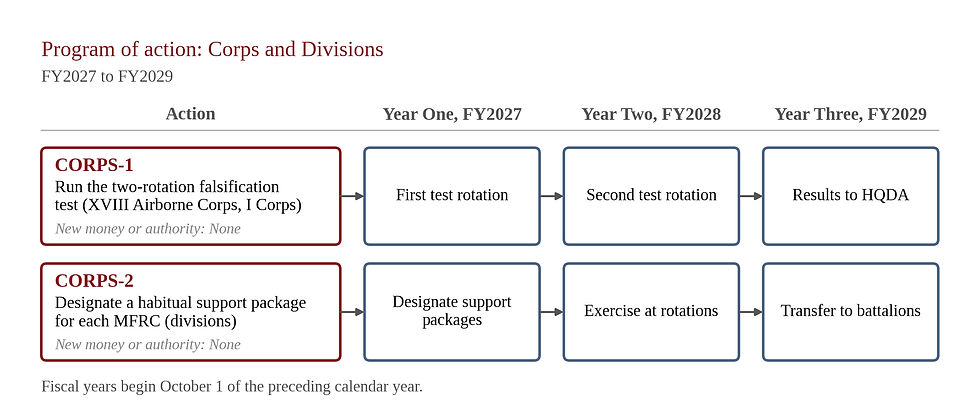
CORPS-1: The corps responsible for the TiC divisions, the XVIII Airborne Corps under Army Western Hemisphere Command and I Corps under U.S. Army Pacific (CRS, 2025a), should run the two-rotation falsification test at scheduled rotations in Years One and Two, with no new money.
CORPS-2: Until a battalion exists, each division should designate a habitual support package from its sustainment units for each MFRC, covering batteries, drone parts, vehicle repair, recovery, and medical evacuation from the brigade deep area, and exercise it in every field training event, beginning in Year One with no new money.
Capability Program Executives

CPE-1: The Army’s capability program executive for command and control and its command and control portfolio acquisition executive, which lead NGC2 (U.S. Army, 2026a), should publish a standard data format and an edge store-and-forward requirement so that sensors used by MFRCs write directly into the common data layer, including when units limit transmissions. The direction is a Year One action requiring no new money; fielding to the MFRCs of the two pilot divisions should follow in Year Two within the existing NGC2 program, and to all MFRCs in Year Three.
CPE-2: Capability Program Executive Intelligence and Spectrum Warfare, which manages the intelligence platform, should require in Year Two that the platform’s next iteration ingest brigade collection from the common data layer across the classification boundary by approved means, and should report the time from observation to availability as a program measure. The program’s own 2026 problem statement suggests it is already moving in this direction (Intelligence Community News, 2026b).
Congress

CONG-1: The armed services committees should require, in the FY2028 National Defense Authorization Act, a report on the sustained coverage the Army’s MFRCs can provide, the status of MFRC doctrine, the time from observation to availability in the data layer, and the results of the falsification test, giving Congress the visibility the GAO found missing during the modularity reorganization (GAO, 2006).
CONG-2: Appropriators should fund the provisional MFRBs in FY2028 as a separately identified item, so their cost and results remain visible, and condition any Army-wide funding on that report.
The MFRB proposed here is small by design. Its headquarters and headquarters company would hold a commander and a staff with sections for operations, intelligence and collection management, fires and airspace, sustainment, and data and communications, and a forward support company would sustain the battalion and, on order, the brigade MFRCs. Measured against the published company range, the two elements amount to about two company-equivalents, or roughly 120 to 400 authorizations per division (CRS, 2025b), a bound rather than a design that the Total Army Analysis would refine. Authorizations could come from three places. The first is growth: the FY2027 request would add 15,000 active soldiers (AUSA, 2026), and a two-division pilot would need at most about 800 of them. The second is structure already scheduled for inactivation; in the National Guard, for example, the first brigade to convert is inactivating its cavalry squadron and engineer battalion in September 2026 (Virginia National Guard, n.d.), and soldiers with reconnaissance experience from such units could form Guard MFRBs rather than leave the field. The third is trade-offs among new formations, which the Total Army Analysis exists to adjudicate; the authors lack the controlled data needed to recommend a specific offset.
The relationship between the battalion and the brigades is the design’s most important feature. The MFRCs stay assigned to their brigades, and each brigade commander keeps a reconnaissance company for the brigade’s own fight. The battalion supplies what the company lacks: a staff when the brigade needs one, sustainment when the brigade cannot reach, and a common standard of training across the division. When the division concentrates its reconnaissance for a deep operation, the battalion commands the companies it is given. This is the arrangement the division artillery uses for fires battalions, and the one a 2018 monograph proposed for cavalry (Dolberry, 2018).
Progress would be judged against measures whose baselines are taken in Year One, with proposed targets for FY2029: at least four ground-plus-sensor NAIs held continuously for 72 hours against a spectrum-contesting opposing force; culmination, if it comes, later than 72 hours; 15 minutes or less from sensor observation to availability in the common data layer; fewer than 10 percent of MFRC reports retyped by hand before reaching the intelligence picture; handovers and passages of lines planned without borrowed planners in every rotation; half as many distinct drone and radio types per MFRC as in Year One; enough trained team and platoon leaders to meet the T2COM-3 requirement; and both the interim planning factors and the techniques publication issued. The targets are the authors’ proposals and should be revised once the baselines are known. Four Year One actions, HQDA-1, HQDA-2, T2COM-1, and the direction in CPE-1, need no new money and no new authority and could begin in the first quarter of FY2027.
The costs, estimated only to order of magnitude and without controlled data, are modest. The Year One actions carry negligible incremental cost because they run within existing staffs, rotations, and programs. Personnel for two provisional battalions, at 240 to 800 authorizations, would cost about 24 to 160 million dollars a year, using a range of 100,000 to 200,000 dollars a year for each active-component authorization. The low end matches the Congressional Budget Office’s estimate of about 99,000 dollars in average annual compensation per active-duty service member in 2002 (Congressional Budget Office, 2004), and the high end allows for two decades of growth in pay and benefits; the Army’s FY2027 request for 80 billion dollars in military personnel funding (AUSA, 2026) is broadly consistent with a figure inside that band once the lower cost of reserve component soldiers is taken into account. Army-wide battalions for an illustrative ten divisions would cost about 120 to 800 million dollars a year.
A battalion command post and vehicles would cost in the low tens of millions of dollars per battalion, once, partly offset by equipment from inactivating units, and data path integration falls within the existing NGC2 and intelligence platform programs. The equipment and integration estimates are held with low confidence, and training pipeline expansion is not estimated because it depends on the requirement T2COM-3 would produce. Set against those costs are the costs of the alternative. The Army’s last attempt to supply division reconnaissance without a dedicated unit consumed an entire brigade for eighteen months of training (Dolberry, 2018), and the reconstitution of division cavalry took nearly two decades from the cut (Bocanegra, 2023). A pilot at the scale proposed here costs a small fraction of either.
Conclusion
The Army built the MFRC for good reasons. The war in Ukraine showed that small drones and electronic warfare can find an enemy faster and more cheaply than soldiers on foot, and the company puts those tools in the hands of a brigade commander. Its soldiers are learning quickly, and the best results in the public record show what sense-and-strike units can do.
The problem is what was left out. In replacing cavalry squadrons that had commanders, staffs, and support of their own, the Army gave the brigade a capable retina and did not build the rest of the eye. The company has no staff to plan and track reconnaissance for days at a time, no organic support to keep its teams and drones in the field, no doctrine to carry its methods from one commander to the next, and a data path that depends on soldiers retyping what their sensors see. A company of its size can watch only a handful of places continuously with little margin, and many more when its sensors can fly, for as long as the enemy lets them.
History suggests the Army will eventually notice. It noticed the loss of division cavalry about twelve years after the cut and began rebuilding it about nineteen years after. It has not rebuilt the long range surveillance units it cut on the strength of computer models. This time the Army is preparing for the war that exposed those gaps, so the signal will come sooner, perhaps at the next rotation and perhaps in the first week of a real war.
The program of action is designed to get that signal early and cheaply. Its first year asks for no new money: publish planning factors, measure every rotation, set a data standard, and begin the force structure analysis. Its second year pilots a small reconnaissance battalion in two divisions and connects company sensors directly to the Army’s common data layer. Its third year decides, on evidence, whether the design should spread. If the two-rotation test shows the company can hold its ground for 72 hours without a headquarters behind it, the Army should keep the current design and set this paper aside. If it cannot, the Army will have learned that in training rather than in combat, and it will have a design ready to build.
Sight is a system. A brigade that can see only when nothing goes wrong has been designed to go blind at the moment it most needs to see. The Army can still build the nerve and the cortex to match the retina it has already paid for.

Comments